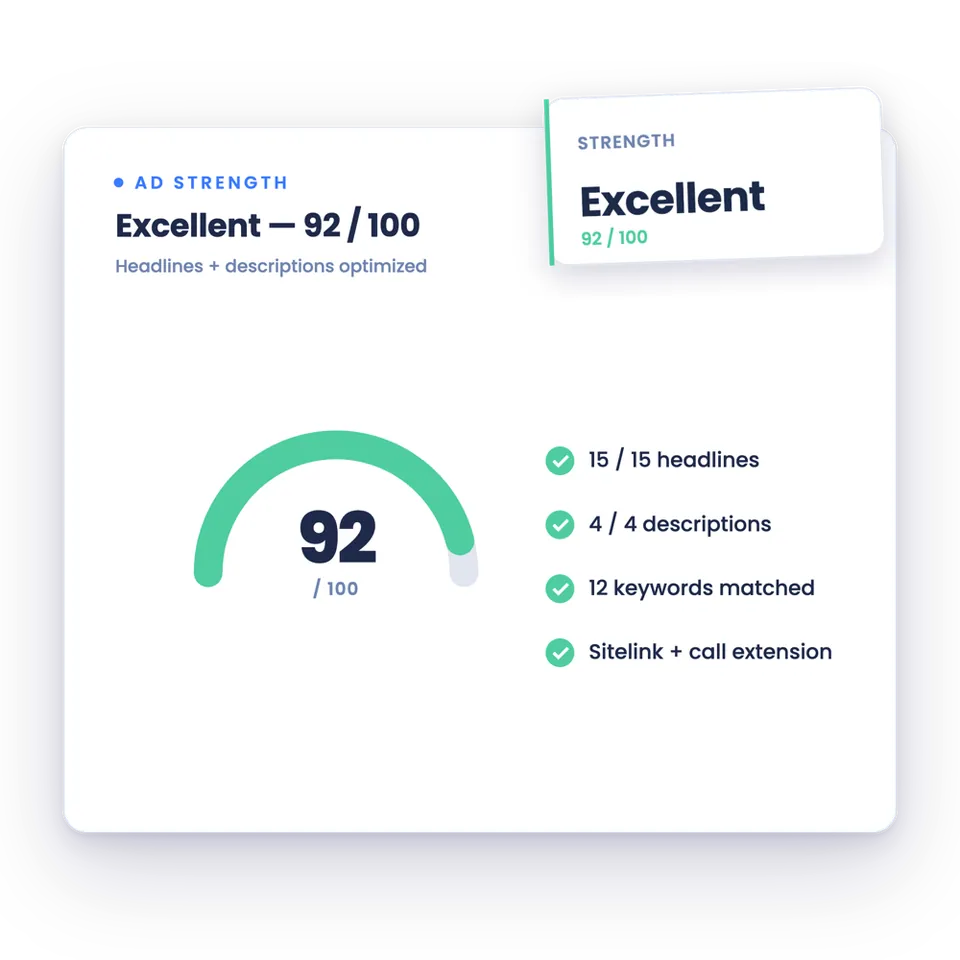
A Google search ad looks tiny, but there's a recipe behind a good one. A responsive ad has 15 headlines, 4 descriptions and 10 to 20 callouts, as of November 2026, and Google mixes them to find what works. Write each part with a job, count every character and keep the search, the ad and the page on one theme.
 1:27Watch the videoGoogle Responsive Search Ad Anatomy and Character Limits
The parts, and the limits you can't cheat
A responsive search ad contains these parts, as of November 2026.
- 15 headlines. Google mixes them to find what works. Each headline runs 30 characters at most.
- 4 descriptions. Each one can run up to 90 characters.
- 10 to 20 callouts. These are short phrases of 25 characters or less.
Count every character before you paste it in. Google won't take a headline that runs long. Short limits make you choose each word, which is a good discipline.
The headline recipe
With 15 headlines, it helps to have a plan for what each one does. Here's the recipe I use.
- Three headlines that match the service. Use the words people actually search.
- Two local ones. One drops the searcher's city in automatically, and one says "near."
- Two credentials. Only claim a license if you really hold it.
- Two outcomes. What the customer gets.
- Two pain questions. The thing they're worried about, phrased as a question.
- One offer. A free consult, a quote, a first step.
- One proof point. Years in business, reviews or a number you can stand behind.
- One call to action. Plain and direct.
That adds up to 15. Each headline gives Google a different angle to test.
Don't pin anything
Pinning locks a headline into a position. It stops Google from testing combinations. If you pin three headlines, you've cut the number of combinations Google can try.
Let it mix. Your job is to write good pieces and trust the testing. Check results over time and swap out what underperforms.
The alignment rule
Here's the rule that saves the most money. If the search, the ad and the page talk about different things, you pay for bad clicks. The searcher wanted one thing, the ad promised another and the page showed a third.
Make all three share one theme. Send each ad group to a page that speaks to that exact search, with a real face on it. A visible person builds trust quickly and shows the visitor they've landed in the right place.
When the three line up, your quality score holds up, and the people who click are the people you wanted. So you can stop burning budget on clicks that were never going to call.
What the descriptions should do
With only four, each description has a job.
- One on the outcome. What changes for the customer.
- One on the service stack. What you do, in a short list.
- One on local trust. Where you work and how long you've been there.
- One call to action. The next step, in plain words.
Keep them specific and free of buzzwords. Short and direct beats polished and vague.
A quick example
This is an illustration only. A tax firm in a mid-size city might write headlines like these, each under 30 characters.
- A service match, such as "Business Tax Planning."
- A dynamic local one that inserts the searcher's city.
- A "near" version such as "Tax Pro Near You."
- A pain question such as "Surprise Tax Bills?"
- A call to action such as "Book a Free Review."
Each one gives Google something different to test. The page they land on says the same thing, with a real photo of the owner and a clear button.
How to check your own ads
- Read the search terms that triggered your ad.
- Read the ad as a searcher would.
- Open the page it leads to.
- Ask whether all three talk about the same thing.
- Count the characters in every headline, description and callout.
- Check that nothing is pinned without a good reason.
If any step fails, fix it before you spend more.
What callouts are for
Callouts are the small extra phrases that can show under your ad. They're short, 25 characters or less, so each one carries a single point.
Good callouts name real features or promises. Examples of the shape include things like a free first review, same day response or serving a named city. They aren't a place for hype. Use what's true about your business, and give Google 10 to 20 so it has options.
How to think about pain questions
A pain question gives a searcher a reason to stop. "Surprise tax bills?" or "Books behind again?" speaks to the feeling behind the search. Keep it short, and phrase it in the words your customers use.
Two pain headlines is plenty. Too many questions can feel like a quiz. Pair them with plain statements that give the answer.
How to review results
Once the ad runs, look at the headline and description performance Google reports, and think about patterns.
- Which headlines show up in the best combinations?
- Which ones rarely get used?
- Which search terms are bringing clicks, and do they match your service?
- Do clicks turn into calls, not just visits?
Swap out weak headlines for new angles from the recipe, and keep what works. Over time your ad gets sharper.
The mistakes to avoid
- Headlines that run over the limit. Count before you paste.
- All headlines saying the same thing. Give each one a different angle.
- Pinning. It blocks testing.
- Claiming a license you don't hold. Never borrow a title.
- Sending every ad to the homepage. Match each ad group to a page about that search.
- A page with no face. Add a real person.
Your Monday morning list
- Open your current search ads and count how many headlines you have.
- Check each against the limits.
- Fill any gaps using the recipe.
- Remove any pins.
- Match each ad group to a page about that exact search.
Not sure if your search ads follow the recipe? Book the $99 audit call at https://www.feedbackwrench.com/book. I'll read your ads next to your pages and tell you what I'd change. You get a scored one page audit and your top three fixes, in order.
Questions people ask
What is a responsive search ad?
"As of November 2026, a responsive search ad has 15 headlines and 4 descriptions, and Google mixes them to find what works. You can also add 10 to 20 callouts, which are short phrases."
What are the character limits?
"Headlines run 30 characters at most, descriptions up to 90, and callouts 25 or less, as of November 2026. Count every one, because Google won't take a headline that runs long."
Should I pin headlines?
"Don't pin anything. Pinning stops Google from testing the combinations."
What headlines should I write?
"Start with 3 that match the service, 2 local ones, 2 credentials and 2 outcomes. Add 2 pain questions, plus one offer, one proof point and one call to action. Only claim a license if you really hold it."
How do I protect my quality score?
"Make the search, the ad and the page share one theme. Send each ad group to a page that speaks to that exact search, with a real face on it."

Rob built Feedbackwrench and Nuance Financial Tax & Accounting. Since 2015, our team has helped transform 550+ small businesses with marketing, strategy and systems.